Loose skin is easy to see. What is happening underneath it is less obvious.
Perhaps the skin on your upper arms feels thinner than it used to or looks slightly crinkled when you lift them. You might notice more fine lines across your chest. On the buttocks, the skin may seem less firm and cellulite or dimpling more noticeable.
Although these changes look different, they can have something in common: the gradual loss of collagen that supports our skin.
This is where the science behind Sculptra becomes interesting.
Rather than simply adding volume beneath the skin, Sculptra encourages your body to make more of its own collagen. The treatment starts the process, then your skin gradually responds over the following weeks and months.
At Dr Kate Aesthetics, collagen-stimulating treatments have traditionally been associated with the face. The same principle can now be applied to selected areas of the body, including the upper arms, décolletage and buttocks.
So, why does losing collagen make skin look loose in the first place, and can encourage the body to make more of it really change what we see?
Why Does Our Skin Become Looser as We Get Older?
Underneath the surface of your skin is a network of proteins, including collagen and elastin.
You can think of collagen as part of the skin’s internal scaffolding. It provides strength and support, while elastin helps the skin stretch and bounce back.
When we are younger, this support network is generally stronger. Over time, we produce less collagen and the collagen already present in the skin changes. Gradually, skin can become thinner, less firm and less springy.
Ageing is not the only reason this happens. Other factors can accelerate the process:
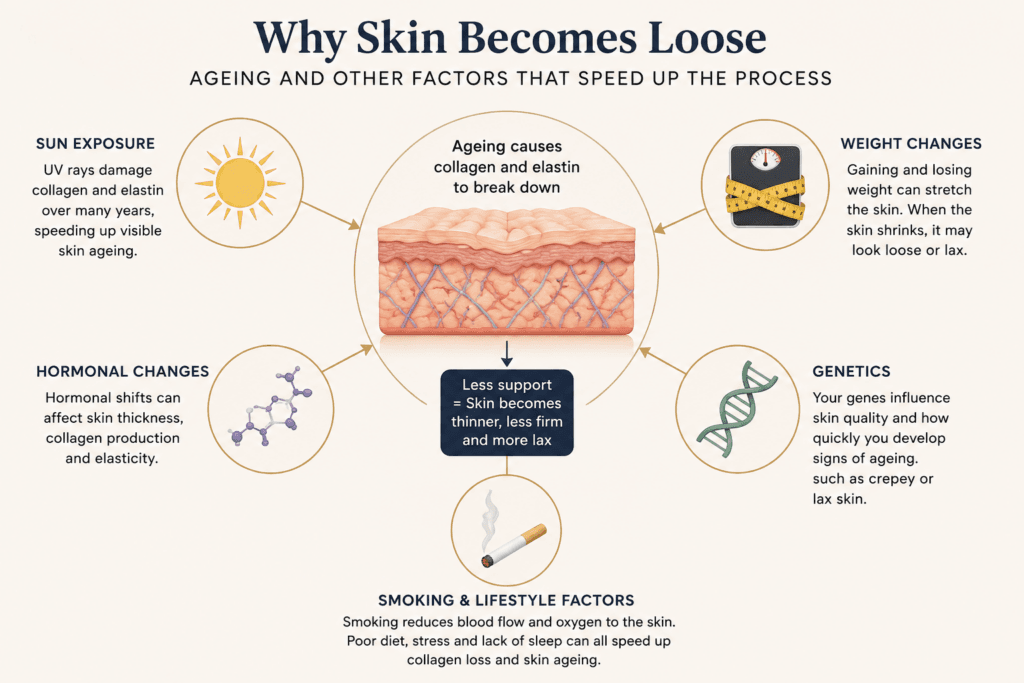
This is why two people of exactly the same age can have very different skin.
How Does Sculptra Encourage Your Skin to Make Collagen?
Sculptra contains an ingredient called poly-L-lactic acid, usually shortened to PLLA.
The name sounds complicated, but the way it works is relatively straightforward. Once injected into the appropriate area, tiny PLLA particles trigger a controlled response within the tissue. This activates cells called fibroblasts, which have an important role in producing collagen.
Over the following weeks and months, these cells gradually produce new collagen around the treated area. Meanwhile, the PLLA itself is slowly broken down by the body.
This is what makes Sculptra different from a treatment designed mainly to create immediate volume. There may be some temporary fullness straight after treatment because of the fluid used during the injections, but this settles. The changes we are looking for develop later, as new collagen forms.
In simple terms, Sculptra provides the stimulus, then your body gradually does the rebuilding.
What Does More Collagen Actually Do to Loose Skin?
Collagen forms an important part of the skin’s internal support structure. When collagen levels decline, the skin can become thinner, weaker and less able to hold its shape.
Encouraging new collagen production aims to strengthen that support from within.
Depending on the area and your starting skin quality, this can gradually help the skin appear:
- Firmer and smoother
- Less crepey
- More resilient
- Better supported
- More even in texture
On the buttocks, improving the strength and quality of the skin may also make some dimpling less noticeable.
Sculptra is not physically pulling loose skin tighter. Instead, it is working within the tissue to improve the structure and quality of the skin, which can help it look and feel firmer over time.
What Have We Learned About Using Sculptra on the Body?
Sculptra was originally much better known as a facial treatment, but its use has developed considerably. It now has European body indications that include the upper arms, décolletage, buttocks and backs of the thighs.
What is particularly interesting is that research has looked at changes in the skin itself, rather than simply whether an area appears fuller.
Studies involving the upper arms have examined skin thickness and elasticity. Research involving the décolletage has looked at wrinkles, smoothness and skin quality, while studies involving the buttocks and thighs have considered firmness, contour and the appearance of cellulite.
This helps explain why body Sculptra should not simply be thought of as a way to add volume. For many patients, the aim is to improve the quality and support of the skin itself.
Can Sculptra Improve Any Type of Loose Skin?
No, because collagen loss is not the only reason skin can look loose.
For example, someone with mild crepiness on the upper arms may have gradually lost collagen and skin firmness with age. Another person may have a significant amount of excess skin following substantial weight loss.
Although both might describe their arms as “loose”, they require very different approaches.
Sculptra may help where reduced collagen and declining skin quality are contributing to mild or moderate laxity. It cannot remove significant amounts of excess skin.
At Dr Kate Aesthetics, this is why we assess what is causing the laxity before deciding whether collagen stimulation is likely to make a worthwhile difference.
Can Sculptra Improve Cellulite on the Bum?
Cellulite is another good example of why we need to look at what is happening beneath the surface.
Under the skin of the buttocks and thighs are connective tissue bands that attach the skin to deeper structures. These bands can pull certain areas downwards while the fat between them pushes upwards, creating the characteristic dimples we recognise as cellulite.
Skin quality also affects how visible those dimples are. When the skin is thicker and firmer, it provides better coverage over the structures underneath. As collagen declines and the skin becomes thinner or less resilient, existing cellulite can become more noticeable.
Sculptra does not release or remove the connective bands that contribute to cellulite. Instead, stimulating collagen may improve the strength and quality of the skin covering them, which can make some dimpling appear less obvious.
This is why Sculptra may help with certain types of cellulite, particularly where reduced skin firmness is part of the problem, but it should not be viewed as a treatment that simply makes cellulite disappear.
Why Do Sculptra Results Take Time?
Quite simply, because new collagen takes time to form.
Sculptra does not contain ready-made collagen and it does not create its intended result simply by remaining underneath the skin. Its role is to stimulate a biological process.
Following treatment, fibroblasts gradually produce new collagen over the coming weeks and months. As this new support develops, changes in skin firmness, texture and quality can become more noticeable.
This explains why Sculptra results are progressive rather than immediate. It also explains why it is described as a collagen stimulator.
Sculptra cannot return older skin to exactly how it was when you were younger. What it can do is encourage your body to rebuild some of the collagen support that has gradually been lost.
The treatment starts the process. Your skin changes gradually afterwards.
FAQs About Sculptra for the Body
What happens to Sculptra once it has been injected?
The PLLA particles are gradually broken down by the body. Their role is to stimulate the collagen-building process rather than remain permanently within the skin.
Does everyone produce the same amount of collagen after Sculptra?
No. Everybody responds differently. Your starting skin quality and individual biological response can influence how much improvement you see and the treatment plan recommended.
Can skincare stimulate collagen in the same way as Sculptra?
No. Good skincare plays an important role in protecting and maintaining healthy skin, particularly against further sun damage, but products applied to the skin and an injectable collagen stimulator work in very different ways.
Am I too young for Sculptra on the body?
There is no single correct age. What matters is whether you have a skin change that Sculptra can realistically improve. Genetics, sun exposure and changes in weight mean some people develop laxity or crepiness earlier than others.
Why can’t Sculptra replace surgery for very loose skin?
Sculptra can improve collagen within the skin you already have, but it cannot remove excess skin. If there is significant loose skin, particularly following substantial weight loss, collagen stimulation alone may not provide enough improvement.
What Is Really Causing Your Loose Skin?
If you are noticing changes to the skin on your arms, décolletage or buttocks, the most useful question is not simply, “Will Sculptra tighten it?” It is why has my skin changed, and is collagen loss part of the problem?
At Dr Kate Aesthetics in Cockfosters, North London, a consultation allows us to assess the quality and laxity of your skin before deciding whether collagen stimulation is likely to make a worthwhile difference.
Depending on what we see, that may mean discussing Sculptra, Morpheus8 or another appropriate treatment available at the clinic.
You can book a consultation with Dr Kate Aesthetics to understand what is happening beneath your skin and which approach may be most appropriate.