Acne may eventually settle, but the changes it leaves behind can be much more persistent.
For some people, the main concern is discolouration left after breakouts. For others, acne has changed the actual texture of the skin, leaving dips, depressions or an uneven surface that becomes particularly noticeable in certain lighting.
This is where treating acne scarring becomes very different from treating active acne.
At Dr Kate Aesthetics, we often see patients who have spent years trying skincare, peels or facials hoping their scars will gradually disappear. These can all have a place in improving skin quality, but once acne has caused a structural scar, treatment usually needs to encourage remodelling deeper within the skin.
This is where laser treatments can become particularly useful. By creating a controlled response within the skin, laser treatment can target uneven texture and stimulate the collagen remodelling needed to improve the appearance of established acne scars.
And if laser treatment for acne scarring is something you have been considering, September can be a particularly sensible time to begin.
Why Is September a Good Time for Acne Scar Laser Treatment?
There is nothing magical about the first day of autumn. The advantage is practical.
CO₂ laser treatment deliberately creates controlled injury within the skin to stimulate renewal and collagen remodelling. Afterwards, the skin needs time to heal and needs careful protection from UV exposure.
During summer, that can be harder than it sounds. Holidays, outdoor events, long evenings and simply spending more time outside can make avoiding strong sun more difficult.
By September, most patients are returning to their usual routines and we are moving towards the lower-UV months of autumn and winter. That can make it easier to plan both treatment and recovery.
It is important to remember that September can still bring bright, sunny days. Starting treatment in autumn does not remove the need for SPF or careful sun avoidance. It simply creates a useful treatment window stretching through autumn and winter, particularly when more than one session may be required.
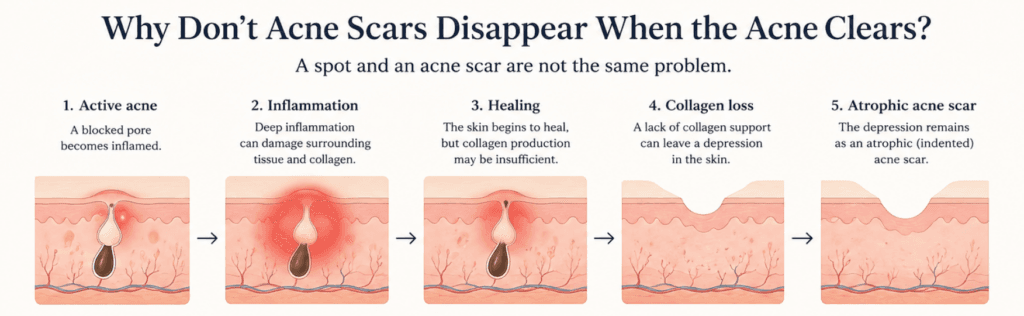
Why Don’t Acne Scars Disappear When the Acne Clears?
A spot and an acne scar are not the same problem.
When acne causes significant inflammation, the healing process can disrupt collagen within the skin. If insufficient collagen is produced during repair, a depression can remain. These are known as atrophic acne scars.
How Does CO₂ Laser Work on Acne Scarring?
CO₂ laser resurfacing works by creating tiny, controlled treatment areas within the skin. With fractional CO₂ technology, the laser is delivered in microscopic columns, leaving small areas of untreated skin in between to support the healing process.
For acne scarring, the treatment works in two main ways:
- At the surface: It resurfaces uneven skin, helping to soften rough texture and make the edges of acne scars appear less noticeable.
- Below the surface: The controlled heat triggers the skin’s natural repair response, encouraging the production and remodelling of collagen.
This is important because many indented acne scars form when inflammation from acne disrupts collagen during the healing process. CO₂ laser treatment therefore does more than address what we can see on the surface. It aims to encourage the skin to gradually rebuild some of that underlying support.
NeoXel CO₂ Laser Resurfacing uses this fractional approach. The depth and intensity of treatment can be adjusted according to the skin and the severity of the acne scarring.
In practice, this means treatment can be adapted for different concerns:
- Milder uneven texture: A lighter level of resurfacing may be appropriate.
- More established acne scarring: A stronger treatment may be considered to encourage greater collagen remodelling.
- Different scar patterns: Treatment can be tailored depending on whether the skin has shallow scars, deeper indentations or more widespread textural changes.
This flexibility matters because acne scarring rarely looks the same from one patient to another. The appropriate treatment depends on what is actually happening within the skin rather than simply the presence of “acne scars”.
Results also take time. Redness, swelling and peeling can occur during the initial healing period, but improvement does not stop once the skin looks recovered. Collagen production and remodelling continue over the following weeks and months, so skin texture can gradually improve.
The goal is not to erase every acne scar in one treatment. Instead, CO₂ laser resurfacing aims to make scarring less noticeable by improving uneven texture and supporting longer-term collagen remodelling.
Is CO₂ Laser Suitable for Every Type of Acne Scar?
No, and this is one of the most important parts of treating acne scarring properly. Two people can both say they have “acne scars” while having very different skin. One may have relatively shallow textural irregularities across the cheeks. Another may have deeper individual depressions. Someone else may have active breakouts alongside scarring and post-inflammatory pigmentation.
Treatment choice also needs to take into account skin type, tendency towards pigmentation, current skin condition, previous treatments and the amount of downtime someone can realistically manage.
For milder cases, we may not necessarily begin with an intensive laser treatment. SkinPen Microneedling, for example, is another treatment available at Dr Kate Aesthetics for acne scars and can stimulate the skin’s natural repair response with considerably less recovery time.
For patients requiring deeper collagen remodelling, Morpheus8 may also be considered. This combines microneedling with radiofrequency energy and is used at the clinic for concerns including acne scars, enlarged pores and skin texture.
For more established scarring where resurfacing is appropriate, we would normally look more closely at whether NeoXel CO₂ can deliver the degree of remodelling required.
The important point is that treatment intensity should follow the scar, rather than assuming everyone with acne scarring needs the strongest treatment available.
When Should You Start Treating Acne Scars?
You do not need to wait years before asking about acne scarring, but active acne needs to be considered before starting an intensive scar treatment programme.
If new inflammatory lesions are continually appearing, there is a risk of treating existing scars while new ones are still developing.
At Dr Kate Aesthetics, we therefore look at the skin as a whole. Is the acne controlled? Are the marks mainly pigment or genuine scars? How deep are the scars? How does your skin respond to inflammation? What treatments have you already tried? Those questions are more useful than simply asking which laser is “best”.
September gives us a useful opportunity to make that assessment and, where appropriate, begin a treatment plan that can continue through the autumn and winter.
FAQs About Laser Treatment for Acne Scars
Can I have CO₂ laser if I still have the occasional spot?
An occasional blemish does not necessarily rule out treatment, but significant or actively inflamed acne may change the plan. Your skin should be assessed before laser treatment is recommended.
Can CO₂ laser make pigmentation worse?
Changes in pigmentation can occur following procedures that create inflammation in the skin, which is one reason skin type, tanning history and individual pigmentation risk need to be assessed carefully before treatment.
How long should I leave between acne scar treatments?
This depends on the treatment used, its intensity and how your skin heals. Your practitioner will recommend appropriate spacing rather than treating again before the skin has adequately recovered.
Can acne scars come back after laser treatment?
An existing scar does not simply “grow back”, although skin continues to change with age. New acne can also create new scars, which is why maintaining control of active acne remains important.
Is winter too late to start acne scar treatment?
Not at all. Autumn and winter can both be useful periods for resurfacing treatments because avoiding prolonged sun exposure is often easier. The right starting point depends more on your skin, lifestyle and treatment plan than a specific date.
Ready to Start Planning Your Acne Scar Treatment?
If acne has settled but the scars are still affecting how you feel about your skin, September is a good time to find out what type of scarring you have and which approach is most appropriate.
At Dr Kate Aesthetics in Cockfosters, North London, your skin can be assessed before a personalised treatment plan is recommended. The clinic is conveniently located for patients from Barnet, Southgate, Enfield, Hadley Wood, Winchmore Hill, Potters Bar and surrounding areas.
Book a consultation to discuss your acne scarring and whether NeoXel CO₂ Laser Resurfacing or another approach is appropriate for your skin.