
When people think about aesthetic treatments, it is easy to focus on individual concerns: lines around the mouth, pigmentation on the cheeks, a slightly softer jawline or skin that simply does not look as fresh as it used to.
In practice, natural-looking results rarely come from treating one isolated feature. The quality of the skin surrounding that feature matters just as much.
Healthy-looking skin has several components. Hydration, texture, tone, collagen, elasticity and structural support all contribute to how fresh and rested a face appears. If one of these is compromised, treating another in isolation may only take you so far.
This is where the idea of a Skin Quality Pyramid becomes useful. Rather than viewing skin quality treatments as separate procedures, it provides a way of thinking about what the skin needs first, what can be built upon and when more advanced treatment may be appropriate.
At Dr Kate Aesthetics in North London, this assessment-led approach helps us create results that look like you, just with healthier, stronger and better-supported skin.
What Is the Skin Quality Pyramid?
Think of skin quality as a pyramid with three broad levels:
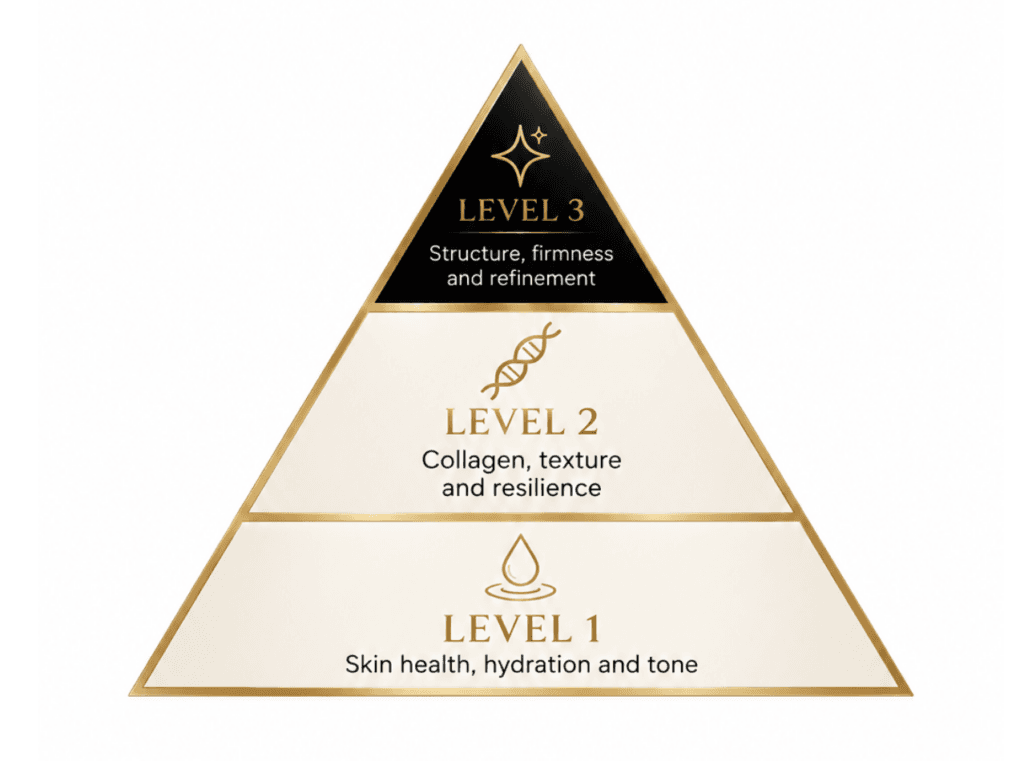
The stronger the foundations, the more effectively we can address the changes higher up the pyramid.
This does not mean every patient needs three stages of treatment. Someone in their late twenties concerned mainly with dehydration may need a very different plan from someone experiencing pigmentation, textural change and increasing laxity in their fifties.
It is a framework for deciding what matters most to your skin now, rather than automatically choosing the treatment you have heard most about.
What Makes Skin Look Healthy and Youthful?
Young, healthy skin tends to reflect light evenly because its surface is relatively smooth and well hydrated. It also has a strong collagen and elastin network beneath the surface, helping it retain firmness and resilience.
With age, environmental exposure and hormonal changes, several things can happen at once. Collagen production reduces, hydration can decline, pigmentation becomes more visible and the skin may become thinner or less elastic. Previous acne, inflammation and sun exposure can also leave changes in texture and tone.
This explains why simply adding volume is not always the answer. If a patient’s main concern is that they look tired, for example, we would assess whether this is actually due to volume loss, or whether dehydration, pigmentation, thinning skin, laxity or a combination of factors is contributing.
Natural-looking aesthetic treatments begin with identifying the cause rather than treating the symptom.
Level One: How Do You Improve Skin Hydration, Tone and Overall Health?
The base of the pyramid is about creating the healthiest skin environment possible.
For some patients, this starts with medical-grade skincare. A carefully selected home routine can address concerns such as dehydration, pigmentation, breakouts and visible signs of sun damage while supporting the results of treatments performed in clinic.
Where we need more information about what is happening beneath the surface, OBSERV 520x skin analysis can also form part of the assessment.
Treatment at this level depends very much on the concern.
For dry or dehydrated skin, injectable skin boosters such as Redensity 1 or STYLAGE® Hydromax may be considered. These use hyaluronic acid-based formulations to improve hydration and overall skin quality without being used primarily to reshape the face.
Profhilo is another option for patients where hydration, elasticity and early loss of firmness are becoming noticeable. It uses hyaluronic acid as a bio-remodelling treatment rather than a conventional volumising filler.
For uneven colour, the approach changes. Lumecca IPL can target selected red and brown pigmentation concerns, including sun damage, freckles and visible vascular changes. Importantly, it is not suitable for every skin type, which is why assessment before treatment matters.
Chemical peels, including the Obagi Blue Peel Radiance, can also be useful where surface texture, brightness and uneven tone are priorities.
The aim at this stage is not to make the face look different. It is to improve the canvas.
Level Two: Which Treatments Improve Collagen and Skin Texture?
Once basic skin health has been addressed, the middle of the pyramid focuses more heavily on the dermis: the layer where collagen and elastin provide much of the skin’s strength and support.
This becomes increasingly relevant when we see:
- Fine lines becoming more persistent
- Enlarged pores or uneven texture
- Acne scarring
- Thinner or less resilient skin
- Early loss of firmness
- Crepey changes around areas such as the eyes, face or neck
For milder textural changes, we may consider medical microneedling. Controlled micro-injuries encourage a wound-healing response and collagen production, making microneedling useful when the goal is progressive improvement rather than changing facial shape.
Polynucleotides take a different approach. They are injectable biostimulators used at Dr Kate Aesthetics to support skin regeneration, hydration, collagen and elastin production. They can be particularly useful in areas where skin quality itself is the concern, including the delicate under-eye area.
Level Three: What If Skin Laxity and More Advanced Ageing Are the Main Concern?
There comes a point where hydration and superficial rejuvenation alone are unlikely to produce the degree of change a patient wants.
If the skin has become noticeably lax, more advanced collagen stimulating treatments may be considered.
Morpheus8 combines microneedling with radiofrequency energy. The microneedles penetrate the skin at controlled depths while radiofrequency energy is delivered into the tissue, stimulating collagen and elastin and remodelling deeper layers. At Dr Kate Aesthetics, it is used for concerns including skin laxity, wrinkles, enlarged pores and acne scarring.
For patients wanting a gentler approach to firmness, Forma uses non-invasive radiofrequency to heat the tissue and stimulate collagen. It can be used independently or as a maintenance treatment following Morpheus8.
Where texture, fine lines, scarring or more significant surface ageing require stronger resurfacing, NeoXel CO₂ Laser Resurfacing may be considered. Fractional CO₂ energy resurfaces the outer layers while stimulating collagen remodelling beneath. Because this is a more intensive treatment with greater downtime, suitability, treatment depth and recovery need careful discussion beforehand.
These treatments sit higher in the pyramid because they are generally addressing more established structural or textural change.
Where Do Collagen-Stimulating Injectables Fit?
Not every structural change requires an energy-based treatment.
Sculptra® is a poly-L-lactic acid injectable that stimulates the body’s own collagen production. Rather than immediately filling an individual line, it works gradually to improve underlying support, facial volume and skin texture.
This distinction is important.
There is a significant difference between replacing volume where it has genuinely been lost and adding volume simply because a patient wants to look younger. Sometimes improving collagen, hydration and tissue quality produces the fresher appearance someone wanted without needing significant volume.
In other patients, hyaluronic acid dermal fillers may still have an appropriate role where structural or volume changes have been identified.
The question should never simply be, “Do I need filler?” It should be: what has changed, and which layer of the face or skin actually needs treating?
Why Does a Personalised Approach Create More Natural-Looking Results?
Ageing does not happen through one process, so one treatment rarely addresses every concern. One patient may have good facial structure but dehydrated, sun-damaged skin, while another may have healthy skin but increasing laxity or volume loss.
This is why the Skin Quality Pyramid is useful. It helps identify where treatment should begin rather than simply choosing a procedure based on age or popularity. Depending on the skin, this might mean addressing pigmentation and skin health first, followed by collagen stimulation, hydration or structural support.
At Dr Kate Aesthetics, treatment choice is based on your skin condition, degree of ageing, medical and treatment history, and what you actually want to improve. For earlier changes, the focus may be on maintaining skin health and supporting collagen. More established concerns may benefit from a carefully sequenced combination of treatments.
There is no single “best” skin quality treatment. The aim is to identify what your skin needs now and build a personalised plan around it, helping improvements remain balanced and natural-looking.
FAQs About Skin Quality Treatments
At what age should I start having skin quality treatments?
There is no set age. Treatment should be based on what is happening to your skin rather than your date of birth. Some people notice dehydration or pigmentation relatively early, while others maintain good skin quality for much longer.
Can I improve my skin quality without having filler?
Yes. Many skin rejuvenation treatments focus on hydration, pigmentation, collagen, texture or firmness without adding facial volume. Whether filler is appropriate depends on whether genuine volume or structural change is contributing to your concern.
How long should I leave between different aesthetic treatments?
This depends entirely on the treatments being combined. Some procedures can form part of the same treatment plan, while others need to be separated to allow inflammation to settle and the skin to recover. Your practitioner should provide a clear sequence rather than simply booking treatments independently.
Is it better to have regular gentle treatments or one stronger treatment?
Neither approach is automatically better. Mild concerns may respond well to lower-downtime treatments and ongoing maintenance, whereas established scarring, texture or laxity may require a more intensive approach. Your tolerance for downtime also matters.
Can skin quality treatments make me look overdone?
Treatments aimed primarily at hydration, tone, texture and collagen do not necessarily alter facial shape. A carefully planned approach is designed to improve the condition of the skin while preserving the features that make you recognisably you.
Building Your Own Skin Quality Pyramid
Good aesthetic medicine is not about collecting treatments. It is about identifying what your skin genuinely needs and creating a plan that supports natural-looking results.
Book a consultation at Dr Kate Aesthetics in Cockfosters, North London, to have your skin, facial structure and concerns assessed and discuss a personalised treatment plan based on your individual needs.


